
Reviewed · IMPERIAL CITY & ROYAL TOMBS TOURS
Hue Imperial City and Forbidden City Walking Private Tour
Hue’s royal walls make sense fast with a guide. This private 150-minute walk through the Hue Imperial City turns a confusing warren of gates and courtyards into a clear story about Nguyen Dynasty power and daily court life, with a private pace that lets you ask questions as you go.
What I like most is the way the guide strings sites together, so you are not just taking photos of monuments. I also like the practical flow, including help with tickets and timing you to spend your energy on the actual palaces and pavilions instead of waiting around.
One thing to plan for: entrance tickets are not included, so you will want cash ready. Also, you are walking inside a big complex, so if rain hits, bring a poncho and expect slippery stone.
In This Review
- Key highlights to look forward to
- Why a Hue Imperial City private walk beats DIY
- Meeting at the Bronze Cannons, then buying tickets the smart way
- Flag Tower and Cua Ngo Mon: the gates that tell you who mattered
- Thai Hòa Palace and the coronation setting you will remember
- Duyệt Thị Đường Royal Theater: when entertainment followed the rules
- Thiệu Phương Garden and Thai Bình Pavilion: the softer side of power
- Kien Trung Palace and Dien Tho: architecture mixing eras and roles
- Temples, epiphanies, and the Nine Dynastic Urns
- Walking rhythm, photo stops, and how to enjoy every gate
- What this tour is best for, and who might want something else
- Should you book this Hue Imperial City and Forbidden City walking tour?
- FAQ
- How long is the Hue Imperial City and Forbidden City walking private tour?
- Is the entrance ticket to the Imperial City included in the price?
- What is included in the tour?
- Where do I meet the tour guide?
- Is this tour private or shared?
- What are some of the main stops during the walk?
- Where does the tour end?
- Do I need cash for tickets?
- Are there combo tickets for Imperial City if I want more than just the citadel?
- What is the cancellation policy?
Key highlights to look forward to
- Bronze Cannon meeting point by the Ngan Gate, with your name on an A4 paper for easy wayfinding
- Gate to palace narration that explains what each space meant, from Nguyen ceremonies to forbidden access rules
- Duyet Thi Duong Royal Theater, the oldest preserved Nguyen theater among four built during the dynasty
- Kien Trung Palace restoration, rebuilt in 2024 after collapse, showing Asian and European influences in one setting
- Nine Dynastic Urns commissioned by Emperor Minh Mang in 1835, with 162 images carved and cast across nine bronze urns
- Designed pace, photo stops plus guided time at major points like Thai Hoa Palace and Thiệu Phương Garden
Why a Hue Imperial City private walk beats DIY
Hue Imperial City can feel like a maze the first time you see it. You will recognize walls, gates, and rooftops, but you might not know which gate matters for the king, which building marked coronation ceremonies, or why the inner purple zone was off limits.
This tour fixes that fast. You get an English-speaking guide who connects the architecture to the rules of the Nguyen court. You also get a schedule that is tight enough to cover the highlights in about 2.5 hours, yet relaxed enough to slow down at the spots you care about, ask follow-ups, and get your bearings without rushing.
I especially appreciate that the tour is private. Even if you are the only person in your time slot, the guide can tailor the pacing. Past tour experiences tied to guides like Nhi, Austin, Ha, and Anna show a pattern of clear explanations and a calm, human approach, not a rehearsed lecture.
More Walking Tours in Hue
- Hue Imperial Ancient City Walking Tour
★ 4.8 · 308 reviews - Eat like a local with a local – Walking Tour
★ 4.9 · 57 reviews - Hue Imperial city walking tour and optional royal tombs
★ 4.7 · 19 reviews
Meeting at the Bronze Cannons, then buying tickets the smart way
You start near the 4 Bronze Cannons area by the Ngan Gate (Cửa Ngăn). Your guide waits with an A4 paper showing your name, which makes the meeting point easy even if your first walk in Hue feels like a sprint.
From there, the tour focuses on getting you into the Imperial City smoothly. Entrance tickets are not included, so budget extra on the day:
- Imperial City ticket: 200,000 VND per adult
- Combo ticket options exist if you plan tomb visits too (420,000 VND for the Imperial City plus 2 Tombs, or 530,000 VND for plus 3 Tombs, valid for 2 days)
The guide helps you purchase tickets. Your best move is to prepare cash in VND ahead of time, since that helps you avoid wasting time at counters. The tour also includes bottled water, which is a small detail, but it helps when you are doing a focused walk in midday light or during humid rain.
If you want to make your whole afternoon easier, this kind of guided ticket step is a quiet value. You are paying for time saved and a smoother entry, not just someone to walk next to you.
Flag Tower and Cua Ngo Mon: the gates that tell you who mattered
The first meaningful stop is the Flag Tower. You get a photo stop plus short guided time, because it is not just a viewpoint. The Flag Tower served as the royal court’s flag-bearing site, and it helps you understand the Imperial City as a place where authority was displayed in plain sight.
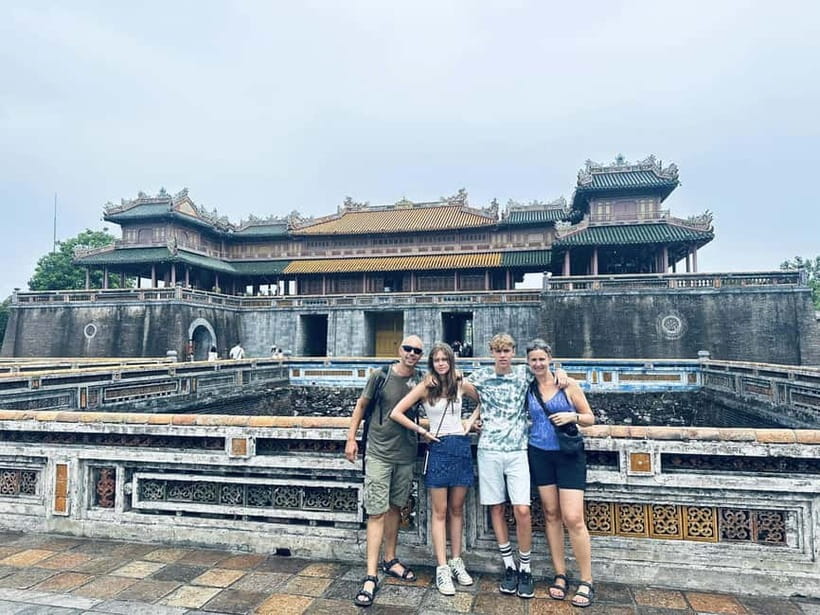
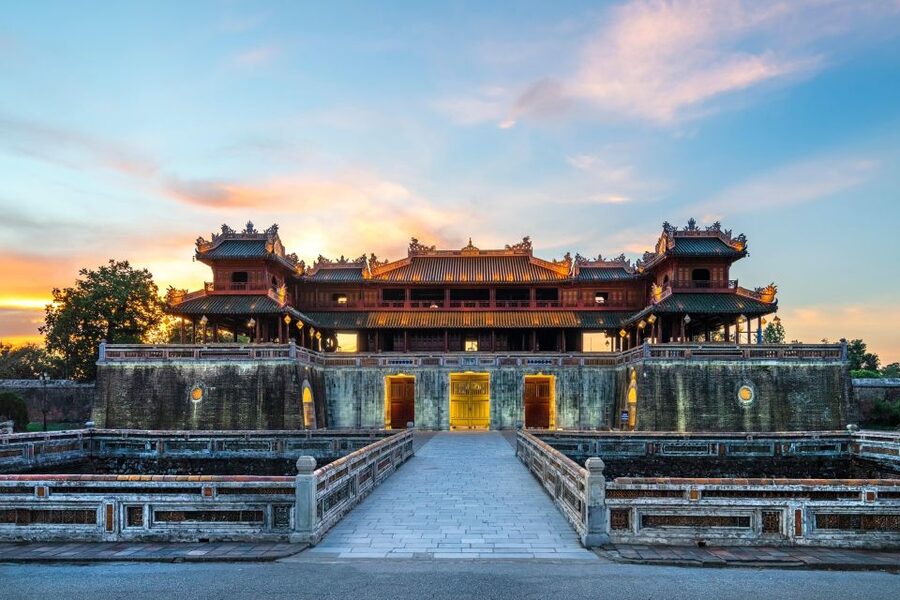
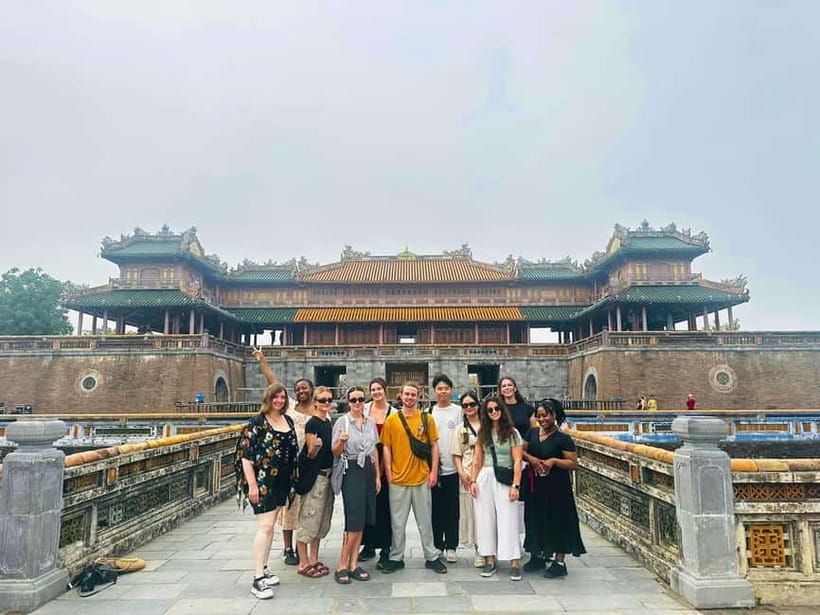
Next comes Cua Ngo Mon (Ngo Mon area). The tour keeps you walking, but the guide does the heavy lifting explaining what you are looking at. The Noon Gate (Ngọ Môn) was built in 1833 and reserved for the king, or used to welcome envoys, so your perspective changes once you realize which entrances were meant for power.
Also watch for the Ngu Phung Pavilion above Ngo Mon Gate. It has an ironwood frame structure with 100 pillars. Even if you cannot read every detail from the ground, knowing what it represents helps you see the place as engineered symbolism, not just architecture.
Practical note: this section is where you may feel the difference between a guided route and wandering. A self-guided stroll gives you buildings. A guided walk gives you the rules behind the buildings.
Thai Hòa Palace and the coronation setting you will remember
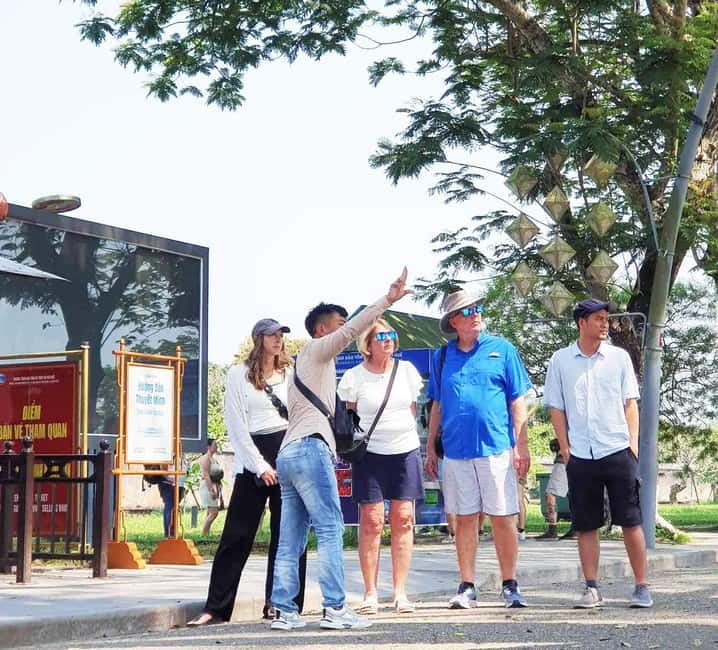
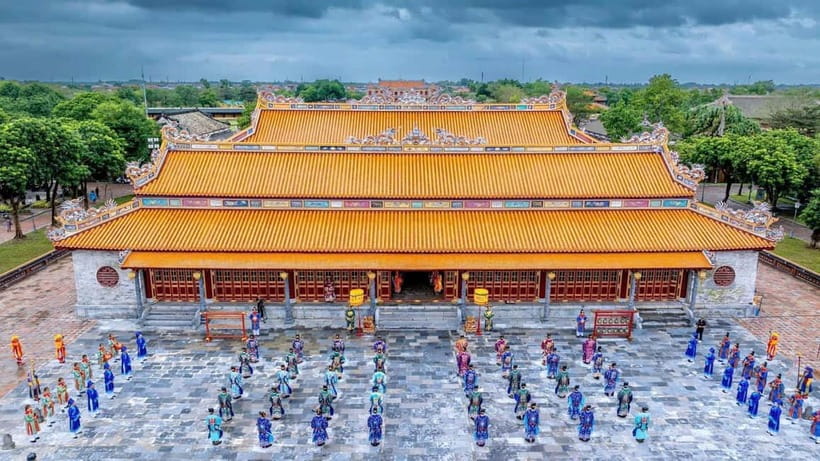
Thai Hòa Palace (Điện Thái Hòa) is the kind of stop where you can feel the weight of the court even if you are not a history person. The guide explains it as the coronation place of 13 Nguyen kings.
That matters. If you view it only as a pretty palace, you miss the point. If you understand that it is tied to coronations, you can look at the space differently: as a stage for legitimacy, ceremony, and order.
This tour also sets up the story behind the Forbidden Purple City (Tử Cấm Thành). You may not walk into every restricted area like the king’s inner circle, but the guide’s explanations clarify what access meant, and why mandarins and civilians were not allowed close to the royal family’s zone. Once you grasp that rule, the inner courtyards feel less mysterious and more intentional.
If you like your travel with a bit of drama and politics, this part delivers.
More Imperial City visits in Hue:
- Hue Customizable Tour with Imperial Citadel & Forbidden City
★ 4.9 · 937 reviews - Hue: Royal Tombs & Pagoda Private Tour By Dragon Boat & Car
★ 4.9 · 257 reviews - Hue: Royal Tombs Private Tour with 3 Best Tombs & Pagoda
★ 4.9 · 213 reviews - Hue: Dragon Boat, Perfume River, Pagoda & Royal Tomb Tour
★ 4.9 · 194 reviews
Duyệt Thị Đường Royal Theater: when entertainment followed the rules
The Duyệt Thị Đường Royal Theater is one of four theaters built during the Nguyen dynasty, and it is also the oldest preserved. That combination makes it more than a cultural side stop. It shows how even public-facing arts stayed under court control.
Your guide’s narration helps you understand why a theater existed inside the imperial complex and what such performances meant within the system of court life. You will get a photo stop, then a guided walk-through of the key things you should notice.
If you have seen theaters elsewhere in Vietnam, this one will feel distinctive because of the age and the direct tie to the Nguyen court. Even if you do not speak Vietnamese, the guide’s context keeps your attention anchored.
Thiệu Phương Garden and Thai Bình Pavilion: the softer side of power
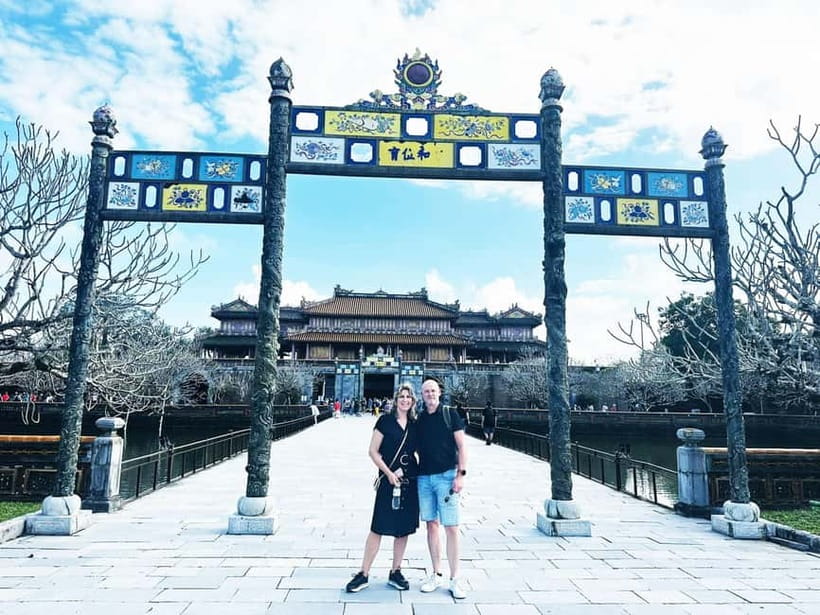
Next, the tour shifts from ceremony to calm. Thiệu Phương Garden was built in 1828 and is one of the typical royal gardens of the Nguyen dynasty.
This is where you get a different rhythm: shorter guided time, more space to look. Gardens in imperial settings were not just for beauty. They were part of how the court balanced authority with leisure, rest, and controlled nature. If the heat or rain is intense, this is also a good spot to slow down and let your senses catch up.
Thai Bình Pavilion (Thái Bình Lâu), built from 1919 to 1921, is presented as a place for the king to rest and relax. This detail helps you remember that the Imperial City was not only built for major events. It was built for the long stretches between events too.
If your legs get tired, these stops are a pleasant trade. You still get meaning, but less rushing.
Kien Trung Palace and Dien Tho: architecture mixing eras and roles
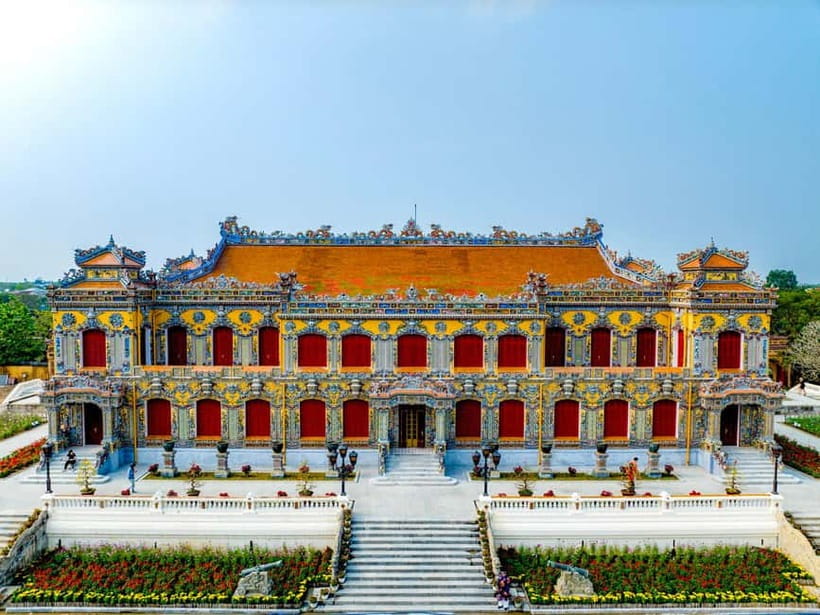
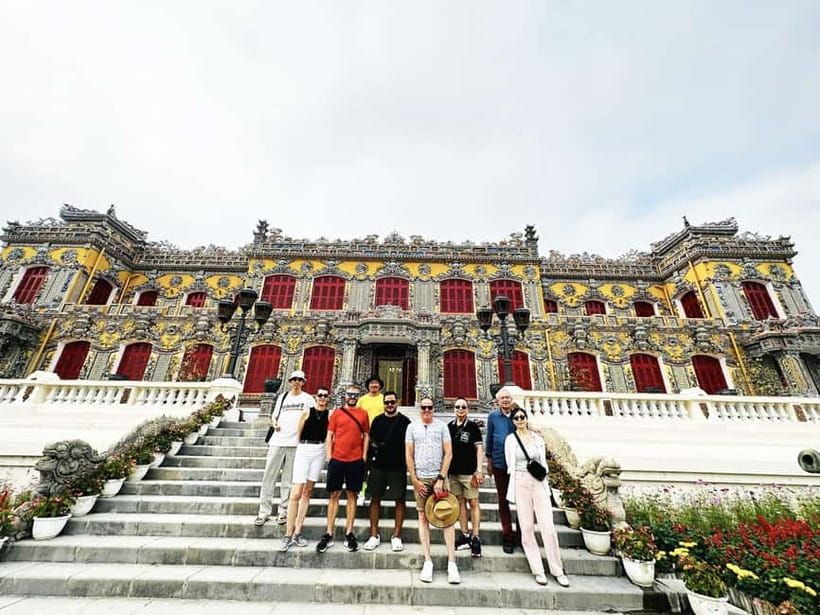
Kien Trung Palace (Điện Kiến Trung) is highlighted for its combination of Asian and European architecture. It was built in 1923, completely collapsed, and was restored in 2024.
That restoration detail is a big deal for how you experience it. You are not just seeing a historic shell. You are seeing a site brought back to life recently enough that you can still spot the “then and now” layers in materials and reconstruction choices. Your guide will help you notice what to look for so you do not miss the point of the mixed architectural influences.
Then the tour heads to Cung Diên Thọ (Dien Tho Palace), the Queen Mother’s residence. The focus here is scale and carved details, plus an elegant style. Even if you only catch glimpses between photo stops, the narration helps you understand why this palace functioned differently from king-centered ceremonial spaces.
This pairing, Kien Trung plus Dien Tho, is smart because it shows power as both public ceremony and private household authority.
Temples, epiphanies, and the Nine Dynastic Urns
The tour continues into the more reflective side of the imperial complex.
You visit the Mieu Temple (Thế Miếu Huế), a temple dedicated to worshiping the 10 Kings of the Nguyen dynasty. This stop can feel quieter than the palaces, but it is powerful if you like how empires remember themselves. The guide ties these worship spaces back to dynastic continuity.
After that, you see the Nine Dynastic Urns (Cửu Đỉnh Huế). These were commissioned by Emperor Minh Mang in 1835. Across the nine bronze urns, there are 162 images cast and carved. That single sentence, 162 images across nine urns, gives you a target for looking. Instead of treating the urns as decoration, you start spotting the idea of curated visual storytelling.
Finally, Hien Lam Pavilion (Hiển Lâm Các) rounds out the tour with a different type of meaning. Built in 1821 to 1822, it is considered the place where emperors had epiphanies. That might sound poetic, but it is also a reminder that rulers were expected to grow, judge, and think within these walls, not only command.
You end at Cửa Hiển Nhơn. By then, the sites you saw earlier stop feeling random and start feeling like a system.
Walking rhythm, photo stops, and how to enjoy every gate
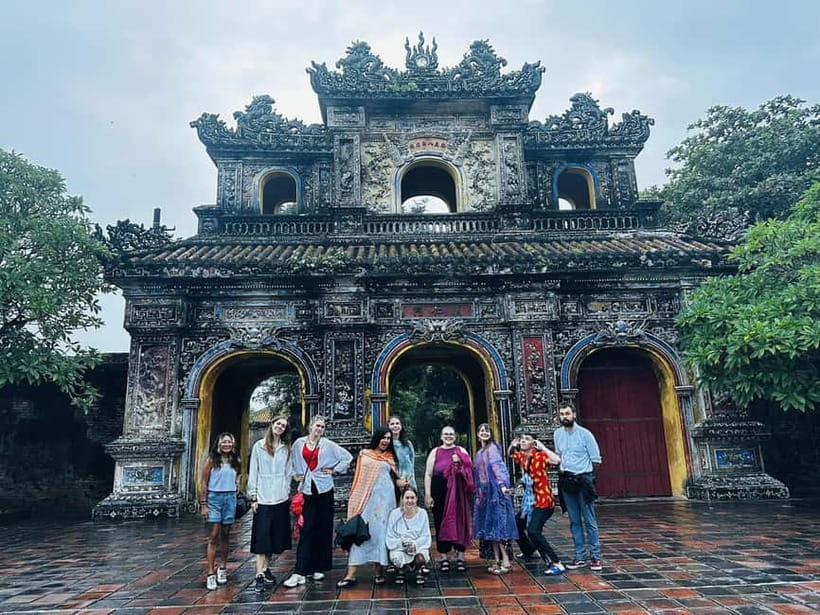
The itinerary structure is built around photo stops plus guided walking time, usually about 10 to 15 minutes at each major point. That matters because it shapes your attention.
Here is how I recommend you use that structure:
- Pick one or two details you care about per stop, then let the guide connect the dots. For example, at Thai Hoa Palace, focus on the coronation link. At the theater, focus on why it was inside the court.
- Take photos, but give your eyes 30 seconds without the camera. This is how the gate rules start to stick.
- If it rains, follow your guide’s pace. One guide, Anna, was noted for coming prepared with a poncho and even a helmet in heavy rain. You might not get the same gear, so pack your own light rain protection.
Also, remember the tour duration is listed around 150 minutes. That means you will cover a lot of ground, but you will still leave the Imperial City with enough time to continue exploring on your own after the tour.
What this tour is best for, and who might want something else
This is a great match if you want:
- Clear explanations of how the Nguyen Dynasty shaped spaces like gates, palaces, and ceremonial zones
- A short but meaningful walk, around 2 to 2.5 hours, without hiring multiple guides or piecing together sites yourself
- A private format that lets you ask questions and go at your preferred tempo
It is also a good choice if you do not want a full-day ticket stress. The guide helps you buy entrance tickets and keeps the flow moving.
You might want a different tour if you are looking for a very long, slow, deep architectural study, or if you want unlimited time inside each individual building. This one is designed for momentum and story clarity within a set window.
Should you book this Hue Imperial City and Forbidden City walking tour?
I think you should book it if your main goal is to understand what you are seeing in Hue’s Imperial City without spending hours researching gate meanings and dynastic context.
At $23 per person, you are paying for an English-speaking guide, a focused 150-minute route, and help with the hardest part of going solo, the ticket step and the interpretation. Add the Imperial City ticket on top, and it still tends to feel like good value because you are not just visiting, you are decoding the place.
If you care about ceremonies, court architecture, and the story behind restricted royal spaces like the Forbidden Purple City, this is one of the easiest ways to get there.
FAQ
How long is the Hue Imperial City and Forbidden City walking private tour?
The tour duration is listed as 150 minutes, and it runs on schedules that can be around 2 to 2.5 hours depending on your selected start time.
Is the entrance ticket to the Imperial City included in the price?
No. The Imperial City entrance ticket is not included. The listed price is 200,000 VND per person.
What is included in the tour?
Included items are an English-speaking guide, bottled water, a 2.5-hour guided tour of Hue Imperial City, and hotel pickup and drop-off if you choose that option.
Where do I meet the tour guide?
Meet the guide at the 4 Bronze Cannons area near the Ngan Gate (Cửa Ngăn). The guide will have an A4 paper displaying your name.
Is this tour private or shared?
This is a private group tour.
What are some of the main stops during the walk?
Stops include the Flag Tower, Cua Ngo Mon, Thai Hòa Palace, the Duyệt Thị Đường Royal Theater, Thiệu Phương Garden, Thai Bình Pavilion, Kiến Trung Palace, Cung Diên Thọ, the Mieu Temple, the Nine Dynastic Urns, and Hien Lâm Pavilion.
Where does the tour end?
The tour finishes at Cửa Hiển Nhơn.
Do I need cash for tickets?
It is recommended to prepare cash in VND to help avoid queuing at the ticket counter, and the guide can assist you with purchasing entrance tickets.
Are there combo tickets for Imperial City if I want more than just the citadel?
Yes. Combo tickets are mentioned as a way to save money, including options that bundle the Imperial City with tomb visits and are valid for 2 days.
What is the cancellation policy?
Free cancellation is available up to 24 hours in advance for a full refund.
More Walking Tours in Hue Vietnam
- Hue Street Food Walking Tour with Local Dishes
★ 4.9 · 14 reviews - Hue: Hue Walking Tour to Imperial Citadel with Tour Guide
★ 5.0 · 10 reviews - Private Street Food Evening Walking Tour in Ho Chi Minh City
★ 5.0 · 3,175 reviews - [HOT] Hanoi Old Quarter Walking Street Food – Small Group Tour
★ 5.0 · 2,163 reviews
New listings around Hue Vietnam
- Hue: Sunset Cruise along Perfume River★ 4.3 · 72 reviews
- Sightseeing Transfer Between Hue and Hoi An★ 4.3 · 13 reviews
- Phong Nha/Dong Hoi: DMZ Tour – Vinh Moc & Khe Sanh Base★ 5.0 · 10 reviews
- Official Hue: Dragon Boat, Imperial Citadel, & Market tour★ 4.7 · 32 reviews
- Hue: Vietnamese Cooking Class in Local Home & Market trip★ 5.0 · 9 reviews
- Hue to Hoi An/Da Nang: Private Scenic Motorbike Tour★ 4.9 · 63 reviews
- Hue to Hoi An via Hai Van Pass by motorbike with Easy Riders★ 5.0 · 16 reviews
- Hue to Hoi An by bus: Hai Van Pass, Lang Co, Marble mountain★ 4.6 · 27 reviews
Imperial City & Royal Tombs Tours, compared.
Hue Customizable Tour with Imperial Citadel & Forbidden City
Read our review →
Imperial City, Hue: Day Tour from Hoi An and Da Nang
Read our review →
Hoi An: Hue Imperial City via Hai Van Pass & Lunch
Read our review →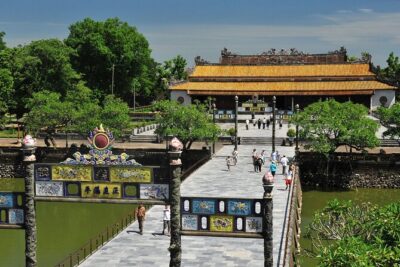
Imperial City Walk, Motorbike Tour & Private Car Options
Read our review →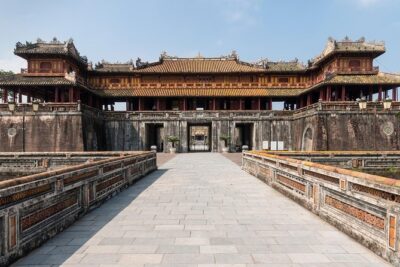
Hue City and The Citadel via Hai Van Pass Daily Small Group Tour
Read our review →
Hue Citadel tour by authentic Train via Hai Van Pass from Da Nang
Read our review →
Royal Tombs & Pagoda Private Tour By Dragon Boat & Car
Read our review →
Royal Tombs Private Tour with 3 Best Tombs & Pagoda
Read our review →Browse the lists this tour appears in