
Reviewed · IMPERIAL CITY & ROYAL TOMBS TOURS
Hue Royal Tombs Tour: Visit Best Pagoda & King’s Mausoleums
Royal tombs in Hue pack a lot fast. This guided trip strings together the key mausoleums and calm pagodas so you understand how Vietnamese royalty lived, and how the tombs were designed for power and faith. I love the efficient 3 to 5 hour format and how a good guide makes the architecture click. My only caveat is that mausoleum entrance fees are extra, so the final spend depends on which tombs you choose.
You get a local expert guide, pickup is offered, and it’s private in the sense that only your group participates. It also has a mobile ticket and group discounts, which is useful if you’re traveling with friends or family. The biggest practical factor is timing, because the stops are spaced to fit a half-day without turning it into a marathon.
You should have moderate physical fitness, since there’s walking on hills and stone paths in Hue’s heat. Also, some places are optional, so you may not see every stop unless you opt in during the day.
In This Review
- Key highlights at a glance
- Why Hue royal tombs work so well in a half-day
- Price and logistics: what $17 really buys
- How the 3 to 5 hour route stays manageable
- Tomb of Khai Dinh: where styles collide on purpose
- Emperor Minh Mang’s mausoleum: ordered space with imperial intent
- Tu Duc Tomb: a palace built before the curtain call
- Thien Mu Pagoda: the quiet icon between tombs
- Tu Hieu Pagoda: a place where ceremonies may be part of the visit
- Dong Khanh Tomb and the UNESCO-style bonus
- Hue Imperial City drop-off: useful if you want a longer self-guided finale
- Guides matter here, especially for architecture
- Who should book this tour (and who might skip it)
- Should you book the Hue Royal Tombs Tour?
- FAQ
- How long is the Hue Royal Tombs tour?
- What is the price per person?
- Does the tour offer pickup in Hue?
- Is this tour private?
- Are entrance fees included for the tombs?
- Are any stops free?
- How many royal tombs does the tour focus on?
- Is food and drink included?
- What if I need to cancel?
- When do I get confirmation after booking?
Key highlights at a glance

- Best-of royal tombs in one outing, including the famous Tu Duc and the standout Khai Dinh
- Architecture with real meaning, especially at Khai Dinh’s blended Vietnamese, Indian, and Western style
- Short stops that still teach, so you leave with names, dates, and design details you can remember
- Two free pagodas that give you a breather from paid tombs: Thien Mu and Tu Hieu
- UNESCO-listed Dong Khanh Tomb option, if you want an extra dose of design history
- Guides who explain clearly, with multiple guides praised for making complex tomb layouts easy to follow
Why Hue royal tombs work so well in a half-day

Hue’s royal tombs can feel spread out, and doing them on your own can turn into guesswork about which one is worth your limited time. This tour is built for that reality. In just a few hours, you’re guided to the tombs that most visitors want to see, plus pagodas that keep the day from feeling like one long cemetery tour.
What I like about this setup is the pacing. You get enough time at each stop to notice details, but not so much time that you get exhausted or bored. It’s a smart match for people who want an overview with context, not a rushed photo sprint.
If you’re visiting Hue on a busy schedule, this kind of focused route also makes your other plans easier. You can still keep the rest of the day open for markets, cafés, or the Imperial City area if that’s your priority.
More Imperial City visits in Hue:
- Hue Customizable Tour with Imperial Citadel & Forbidden City
★ 4.9 · 937 reviews - Hue: Imperial City Walk, Motorbike Tour & Private Car Options
★ 5.0 · 732 reviews - Hue Imperial City Walking Tour: Citadel & Forbidden City
★ 5.0 · 280 reviews
Price and logistics: what $17 really buys
The tour price is listed at $17 per person, and that is the baseline cost for the guided experience. The key thing to know is that entrance fees for mausoleums are not included, listed at ₫150,000 per person per mausoleum site.
That means the final cost depends on how many paid tombs you visit. Pagodas like Thien Mu and Tu Hieu are marked as free entry, so those help offset the paid sites. There’s also an optional stop at Hue Imperial City (the Citadel) where you would buy your own entry ticket.
So here’s the practical value equation I’d use: if you want a guided “best of” route and you’re planning to pay for at least a couple of tomb entrances anyway, the $17 price can be fair. If you’d rather only do one or two paid sites, you might want to choose the stops carefully so you’re not stacking extra entrance fees.
How the 3 to 5 hour route stays manageable

This is a 3 to 5 hour outing, which is long enough to see major sites but short enough that you’re still fresh afterward. The stop durations are brief on purpose, with many stops around 30 to 45 minutes.
Pickup is offered, so you don’t have to deal with sorting transport at the start. And since it’s private for your group, the guide can keep the pace realistic. If someone needs a bathroom break or a slower moment, you’re not stuck with a fixed bus schedule.
The optional nature of some stops also matters. You can tailor what you focus on, like choosing between major tombs. That flexibility is helpful in Hue, because weather, energy level, and your personal favorite emperor can change what you want most.
Tomb of Khai Dinh: where styles collide on purpose

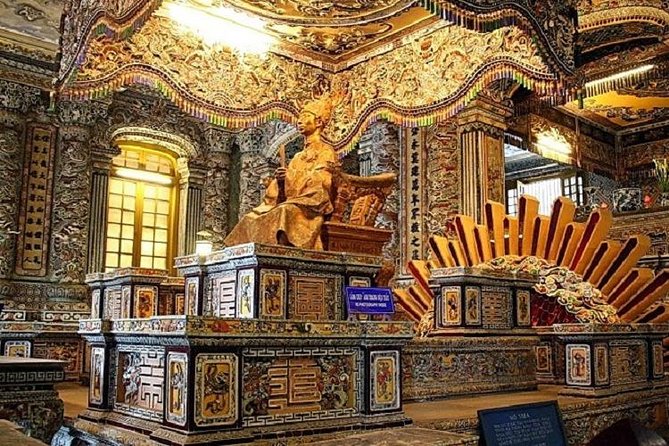
Khai Dinh is the tomb that many people remember because of its unusual design. It’s described as the only Nguyen Emperor tomb built with blended architecture of Vietnamese, Indian, and Western influences. That mix is not random. It’s part of the story of the Nguyen court reaching outward while still asserting its own identity.
Expect about 30 minutes here. It’s long enough to take in the overall plan and notice material and layout choices, but not so long that you’ll feel trapped if the heat is pushing hard.
One consideration: since entrance fees for mausoleums are extra, you’ll want to go into Khai Dinh understanding that it’s one more paid site. If you’re counting costs, this is still a strong pick because the architecture style is one of the most distinctive things in the area.
More Hue plans to weigh
- Hue to Hoi An ( Hoi An to Hue) Top Gear with Lefamily Riders Tours ( 1 way)
★ 5.0 · 3,156 reviews - Easy Rider private tour via Hai Van pass from Hue – Da Nang – Hoi An (1Way|Loop)
★ 5.0 · 1,542 reviews - Easy Rider From Hue Da Nang Hoi An Via Hai Van Pass With Mister T
★ 5.0 · 769 reviews - Hue to Dn/Hoi An: Hai Van Pass, beaches & Mt Monkey or vice versa
★ 5.0 · 743 reviews
Emperor Minh Mang’s mausoleum: ordered space with imperial intent

The Minh Mang tomb stop runs about 45 minutes, and it’s built around a family and dynasty story. The description notes it was built from 1840 to 1843, connected to Minh Mang’s son, Thieu Tri. It also points out that the tomb’s literal name is Hieu Lang, built by Emperor Thieu Tri.
What’s valuable here is the way imperial authority shows up through planning. Even without getting technical, you can often see how tomb design reinforces hierarchy and ritual. A good guide can help you read what you’re looking at, instead of just following pathways and taking pictures.
As with Khai Dinh, this is a paid mausoleum stop based on the ₫150,000 entrance fee listed for mausoleums. If your goal is to hit the biggest names without overspending, Minh Mang is a solid choice because it comes with a clear timeline and a strong connection to the Nguyen dynasty’s internal succession.
Tu Duc Tomb: a palace built before the curtain call

Tu Duc’s tomb often works best as a “wow, that’s different” stop. The key point from the description: Tu Duc began planning his tomb long before he died in 1883. The major areas were built from 1864 to 1867, and later temple buildings were added.
Another detail that makes it more than a single grave site is the use of parts of the complex as a royal palace for Tu Duc and his wives. That’s why many people feel Tu Duc is less about quiet burial and more about a residence for a ruler’s final years.
Expect about 45 minutes. This is a good amount of time because Tu Duc tends to have enough moving parts that you’ll appreciate an explanation for the layout. If you want to understand the site instead of simply walking through it, this is the stop where a strong guide matters most.
And yes, it’s still a paid mausoleum entrance with the ₫150,000 fee. The payoff is that Tu Duc gives you both timeline and function, which makes it easier to remember later.
Thien Mu Pagoda: the quiet icon between tombs
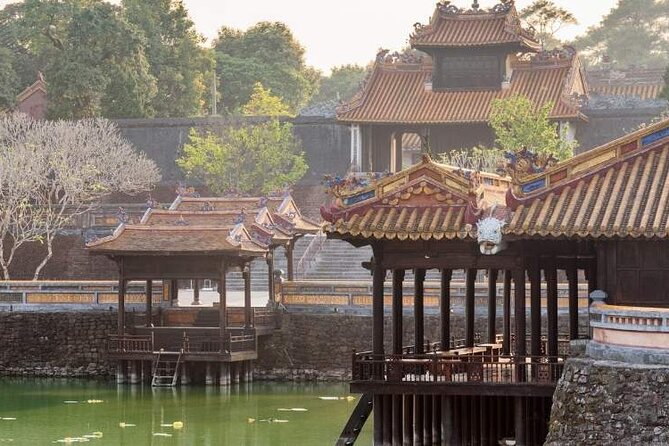
After the tombs, Thien Mu is your calmer reset. It’s described as peaceful and iconic, situated on Ha Khe Hill and overlooking the area around Hue. That hilltop setting is one reason it feels like a break instead of another tough walking stop.
The duration here is about 30 minutes, and it’s marked as free entry. That’s a real bonus, especially if you’re trying to keep the day’s costs predictable.
What I appreciate about Thien Mu in a route like this is contrast. You go from mausoleums designed for imperial memory to a religious monument that feels more connected to daily spiritual life and local identity. Even if you’re not a temple person, it helps your brain switch gears.
Tu Hieu Pagoda: a place where ceremonies may be part of the visit

Tu Hieu Pagoda is another free stop and it’s described as an ancient Vietnamese pagoda that’s worth seeing. The listing notes you can take part in ceremonies such as chanting sutras or offering incense.
The time here is about 30 minutes, which is enough to look around without feeling rushed. If you like cultural participation, this is the stop where you might feel most connected, because it’s not only architecture, it’s practice.
Because the tour includes both Thien Mu and Tu Hieu, you get two different kinds of calm. Thien Mu gives you an iconic hilltop viewpoint. Tu Hieu adds the feel of older, more local religious rhythm.
Dong Khanh Tomb and the UNESCO-style bonus
Dong Khanh is listed as an optional stop and described as having a unique Asian-European architectural style. It’s also noted as recognized by UNESCO as a world cultural heritage site.
This stop runs about 30 minutes. It’s another mausoleum, so entrance fees for mausoleums likely apply, since the ₫150,000 fee is listed for each mausoleum.
If you’re already spending money on multiple tomb entrances, Dong Khanh can be worth it because it adds architectural variety. It gives you one more example of how design choices express the Nguyen era’s connections and ambitions.
Hue Imperial City drop-off: useful if you want a longer self-guided finale
The Hue Imperial City (the Citadel) is an optional finishing point. The tour offers either a drop-off where you can buy entry ticket and explore on your own, or a return drop-off depending on what you prefer.
Because the Imperial City has its own admission, you’re not paying for it through this tour. But the logic is great: you get a location advantage at the end of the day, when you’re still in the right neighborhood for independent exploring.
In practice, this fits well if you’re the type who likes to wander after the guided part. If you prefer keeping the day tight and low-effort, you can skip this add-on and head back.
Guides matter here, especially for architecture
The biggest praise in the provided notes is about the guides and the way they keep the experience engaging. Names that show up include Hung and Lam, both praised for clear explanations and for helping visitors make sense of architecture.
One review specifically highlights Hung for detailed explanations, and another praises Lam for giving insight into architectural designs and cultural forces at the time the tombs were constructed. That type of context is exactly what turns a tomb from scenery into understanding.
Lam also gets a mention for being great with children aged 5 and 9, which tells you something important. This tour can work for families, not only couples and history buffs, as long as your guide can pace the visit to your group.
Also, one note says the guide kept interest even in the heat. Hue can be intense, so having someone who can keep momentum and explain without dragging the day out is a real value.
Who should book this tour (and who might skip it)
This is ideal if you want a guided “best-of Hue” approach without committing to a full day. It’s also a good fit if you care about the design choices behind each tomb, not just the photo stops.
If you’re traveling with kids, you have a strong chance this route can still work, since at least one guide is noted as effective with young children. The half-day format helps too, because it reduces the risk of meltdown and fatigue.
If you’re the kind of traveler who dislikes guided tours and prefers to roam at your own pace, you might find the fixed time windows limiting. Still, the optional stop choices can make it feel more flexible than a rigid full-day tour.
Finally, keep your expectations tuned to moderate fitness. You’ll likely be walking and moving through complex grounds, including hilltop viewpoints at pagodas.
Should you book the Hue Royal Tombs Tour?
I think this is worth booking if you’re visiting Hue for a few days and want a guided hit list. The price is low for what you get, and the free pagodas help keep costs from spiraling. Most importantly, strong guides like Hung and Lam can turn tomb visits into stories you can actually retell.
I’d be cautious if entrance fees feel like a big deal in your budget, because mausoleum entry is ₫150,000 per mausoleum and the total depends on which stops you choose. If you decide to go, I’d choose your tombs thoughtfully, so you’re paying for the ones you most want to experience.
If you want a smart half-day plan in Hue, this one does the job.
FAQ
How long is the Hue Royal Tombs tour?
The tour lasts about 3 to 5 hours.
What is the price per person?
The price is $17.00 per person.
Does the tour offer pickup in Hue?
Yes, pickup is offered.
Is this tour private?
Yes. Only your group will participate.
Are entrance fees included for the tombs?
No. Entrance fees for each mausoleum are not included, and the listed fee is ₫150,000.00 per person per mausoleum.
Are any stops free?
Yes. Thien Mu Pagoda is free, and Tu Hieu Pagoda is also free. Hue Imperial City requires your own entry ticket if you choose to explore it.
How many royal tombs does the tour focus on?
The tour is designed around visiting major royal tombs, with the main stops featuring Khai Dinh, Minh Mang, Tu Duc, and optionally Dong Khanh.
Is food and drink included?
No. Food and drinks are not included.
What if I need to cancel?
Free cancellation is available. You can cancel up to 24 hours in advance for a full refund.
When do I get confirmation after booking?
Confirmation is received within 48 hours of booking, subject to availability.
New listings around Hue
- Top Gear with EasyRider Hue to Hoi An or Hoi An to Hue★ 5.0 · 222 reviews
- Top Gear Hai Van Pass Hue to Hoi An or Da Nang★ 5.0 · 101 reviews
- Taxi Hue airport to city center★ 5.0 · 9 reviews
- Full-Day Private Motorbike Tour in Hai Van Pass with Lunch★ 5.0 · 224 reviews
- JEEP TOUR: From HOI AN, DA NANG To HUE via HAIVAN PASS★ 5.0 · 54 reviews
- PRIVATE JEEP TOUR: From Hue To Hoi An, Da Nang via Hai Van Pass★ 5.0 · 115 reviews
- Hue Food Tour: Central Vietnam Culinary Heritage (Small Group)★ 5.0 · 42 reviews
- Hue Royal Tombs Tour- 3 Most Beautiful Tombs Of Nguyen Dynasty★ 5.0 · 10 reviews
Imperial City & Royal Tombs Tours, compared.
Hue Customizable Tour with Imperial Citadel & Forbidden City
Read our review →
Imperial City, Hue: Day Tour from Hoi An and Da Nang
Read our review →
Hoi An: Hue Imperial City via Hai Van Pass & Lunch
Read our review →
Imperial City Walk, Motorbike Tour & Private Car Options
Read our review →
Hue City and The Citadel via Hai Van Pass Daily Small Group Tour
Read our review →
Hue Citadel tour by authentic Train via Hai Van Pass from Da Nang
Read our review →
Hue Imperial City Walking Tour: Citadel & Forbidden City
Read our review →
Royal Tombs & Pagoda Private Tour By Dragon Boat & Car
Read our review →Browse the lists this tour appears in