
Reviewed · WORKSHOPS
Hanoi Knife-Making Class:Join the Legacy in Blacksmith’s Workshop
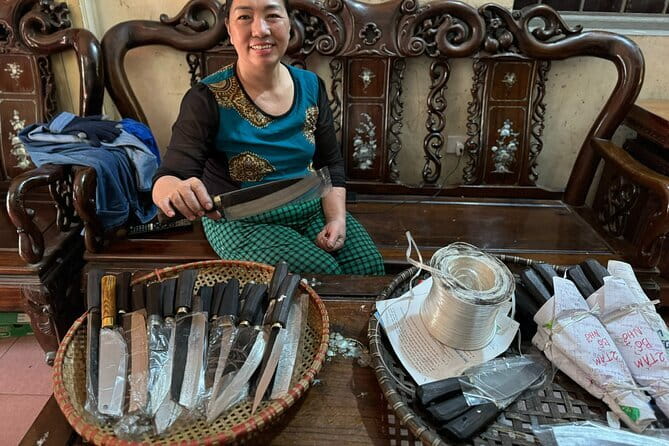
Steel and fire, then your own knife. In Da Sy, a centuries-old blacksmithing village near Hanoi, you work in a real workshop and learn from a female-led forge. I like that the steps are practical, not just watching, and the process includes tar-based sharpening, a rare technique tied to family know-how. One thing to consider: this is active, hands-on work with heat and grinding, so it is not a slow, sit-and-snack experience.
I also like how the class stays personal. With a maximum of 10 people, you get real attention as you sketch a blade design, cut and forge the metal, and then refine it on tools like a grindstone and a hydraulic machine. If you plan to fly home, keep in mind you will be making a working knife, so you will want to check what your airport allows.
In This Review
- Key Points You Can Expect From This Hanoi Knife Class
- Da Sy Blacksmith Village: The Real-Workshop Feeling You Want
- The Female-Led Forge and the 44-Year Craft Legacy
- From Sketch to Tang: Your Step-by-Step Knife Making Journey
- 1) Design and metal selection
- 2) Forging: cut, heat, hammer
- 3) Shaping with help from a hydraulic machine
- 4) Sharpening on the grindstone
- Tar-Based Sharpening: The Family-Secret Step You Will Remember
- Your Take-Home Knife: A Working Souvenir Worth the Effort
- Tools, Safety, and Group Size That Keeps You From Getting Lost
- Price and Value: Is $45.51 Worth It?
- Who Should Book This Hanoi Knife-Making Class
- Should You Book This Hanoi Knife-Making Class or Skip It?
- FAQ
- How long is the Hanoi knife-making class?
- Where does the class start and finish?
- How much does it cost?
- Is a mobile ticket provided?
- What is included in the class?
- Do I get to make the knife myself?
- Is the tar-based sharpening technique part of the experience?
- How many people are in the group?
- Are service animals allowed?
- Is gratuity included in the price?
- What is the cancellation refund window?
Key Points You Can Expect From This Hanoi Knife Class
- Da Sy is a knife-making village with historical roots, once known for supplying weaponry during Vietnam’s wars.
- A female master leads the forge, described as the only officially recognized female artisan in this trade, with 44 years in the craft.
- You make the knife yourself, from design and metal selection through forging, shaping, and sharpening.
- You use real tools and process steps, including a hydraulic machine to help smooth out rough edges.
- Sharpening includes a tar-based wash, described as a family secret passed down through generations.
- Small groups help you learn, with a maximum of 10 travelers and tools provided at the artisan’s house.
Da Sy Blacksmith Village: The Real-Workshop Feeling You Want
This class is set in Đa Sỹ, in the Hanoi region, in a place known for forging blades for centuries. The setting matters. Instead of a craft “set,” you are working in the rhythm of a working workshop where blacksmithing is part of local history.
A big hook here is that the craft is tied to resilience. Da Sy was once known for making weaponry during historical wars, and the class frames knife-making as a tradition that kept going through generations, even as the world changed. You get more than a souvenir. You get context for why people kept the techniques alive.
The class runs about 2 hours 30 minutes. It is long enough that you actually touch each phase of the job, not just the fun part. And because it is capped at 10 people, the pace stays teachable.
More Hanoi plans to weigh
- Hanoi Jeep Tour: Food, Culture and Fun by Vietnam Army Jeep
★ 5.0 · 15,222 reviews - Full-Day Ninh Binh Highlights Tour from Hanoi
★ 5.0 · 7,761 reviews - Hanoi: Ha Long Bay Day Cruise – Swimming, Meal, Kayaking
★ 4.7 · 7,415 reviews
The Female-Led Forge and the 44-Year Craft Legacy
What makes this experience especially memorable is the person doing the teaching. The workshop highlights the only officially recognized female artisan in the trade, credited with 44 years of experience preserving the craft. That matters because knife-making is often presented as purely male-coded in pop culture, and here the guide role stays front and center.
You may meet a lead artisan named Tuyên in the class experience stories, and interpreters show up too. Names like Mint, Nick, and Tulip appear in class write-ups as guide or interpreter support. Even with different helper roles, the consistent message is clear: you are not left to guess what comes next.
As you work, you are guided step by step with instruction that matches your skill level. That is a practical kind of comfort, the kind that helps you avoid wasting materials or missing key steps. It also makes the whole process feel respectful, not rushed.
From Sketch to Tang: Your Step-by-Step Knife Making Journey
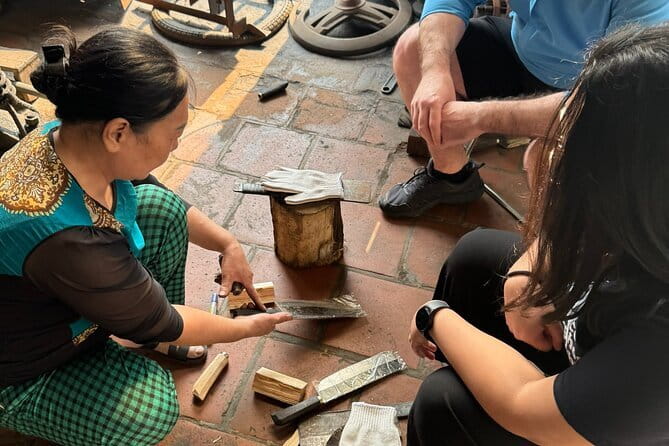
The workshop follows a logical flow, and you will feel it in your hands.
1) Design and metal selection
You start by sketching your blade. Then you choose metal that is durable and suited to a blade, not random stock. This is where you start making small decisions that affect how the knife will feel at the end.
The design step is more than decoration. It sets the shape you will cut, forge, and sharpen, so you see how your choices translate into a real tool.
Same region, different pace:
- Hanoi: Water Puppet Show Tickets
★ 4.6 · 7,029 reviews - Hanoi Motorbike Tour: Food, Culture and Fun by Vintage Motorbike
★ 5.0 · 6,699 reviews - Hanoi: Guided Food Tour with Train Street Visit
★ 4.9 · 6,239 reviews - Hanoi Cooking Class: Culture, Local Market & Meaning CSR Impact
★ 5.0 · 5,147 reviews
2) Forging: cut, heat, hammer
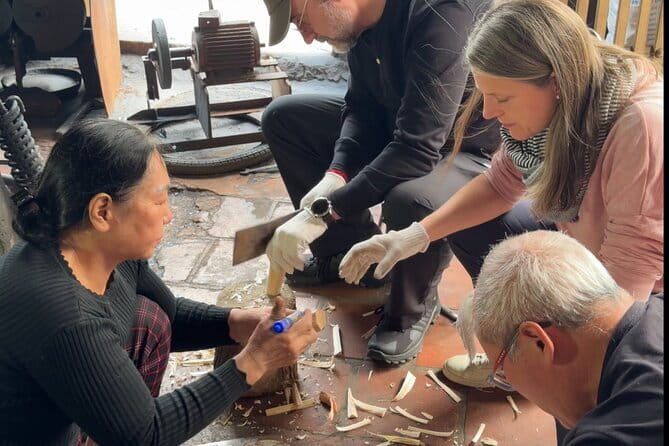
Next comes forging. You cut out the blade and the tang, where the tang is the part that will fit into the handle. Tools like hammers and cutters, plus an anvil, are part of the work.
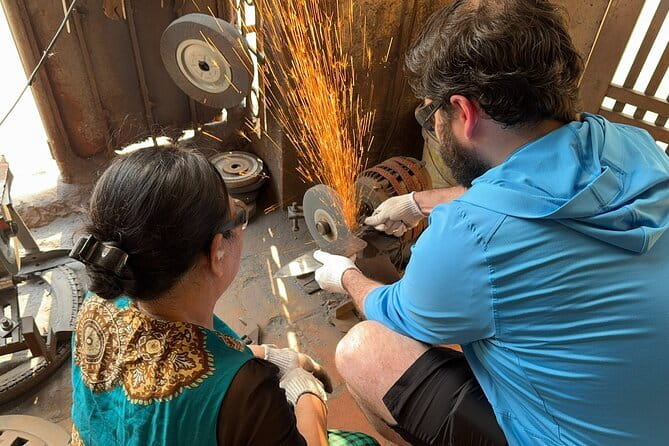
Heat is a key part of the process. You heat the metal in the forge so it becomes workable, and then you shape it. This is where the class gets physical. You will take turns hammering and doing the parts you can handle safely.
3) Shaping with help from a hydraulic machine
After forging, you move into shaping. You hammer the metal into the desired form with artisan guidance, then refine edges. A hydraulic machine is mentioned as helping smooth out rough edges for a cleaner finish.
That detail matters because it shows this is not just “romantic handwork.” It is traditional technique supported by practical tools that help the blade look right without turning the day into pure trial and error.
4) Sharpening on the grindstone
Finally, you sharpen. The class includes several sharpening steps, with a moment that makes this workshop stand out: a tar-based wash technique.
You work the blade on a grindstone, following the sequence the artisans use. The tar wash is described as a rare, age-old method passed down through generations, and it becomes part of the feel and finish of the blade at the end.
Tar-Based Sharpening: The Family-Secret Step You Will Remember
Most knife-making workshops talk about sharpening in a general way. Here, the workshop calls out an unusual ingredient in the process: a tar-based wash.
It is described as a family secret technique connected to Vietnam’s long-running blade tradition. You do not just learn the idea. You see it as part of the sharpening sequence that helps shape the final result.
This step also gives you a useful takeaway for home appreciation. You start to understand that a good knife finish comes from more than one motion. It comes from a process, including cleaning and preparation steps that help the blade work the way it should.
Your Take-Home Knife: A Working Souvenir Worth the Effort
Yes, you take the knife home. This is one of the strongest value signals in the experience, because you are paying to leave with a tool you made yourself, not a framed craft or a decorative item.
You are guided to design and forge a blade that reflects your own choices, and the final knife becomes a functional souvenir you can actually use for cooking. That kind of keepsake is rare, and it is why the class gets such strong praise.
One practical note if you fly: knife rules vary wildly by country and airport. In at least one class story, the finished knife length mentioned was about 14 cm, and the person then had to check whether they could bring it. Plan ahead so your “bring home” goal does not turn into a surprise at security.
Also, treat it like a real tool. After you make something hot and sharp, you respect it. That is part of the cultural message of the class too.
Tools, Safety, and Group Size That Keeps You From Getting Lost
All tools are provided at the artisan’s house, along with safety equipment for knife making. That is not just convenient. It means you can focus on learning the process instead of searching for equipment or guessing what is required.
The class includes an expert artisan guiding you through the steps. The workshop language is supported by guides or interpreters, so you are not stuck without context as the techniques change from design to heat to grinding.
The class is limited to a maximum of 10 travelers, which helps in two ways. First, you are not fighting for attention. Second, the workshop can keep the flow moving without turning into a crowded production line.
In general, most travelers can participate. And the experience allows service animals. The meeting point is in Đa Sỹ, Kiến Hưng, Hà Đông, Hà Nội, and the activity ends back at the meeting point.
Price and Value: Is $45.51 Worth It?
At $45.51 per person, this is not a “cheap craft” and it is also not priced like a luxury tour. What makes it feel like good value is that you get instruction plus all the equipment you need, and you leave with a hand-made knife.
Many craft classes give you a quick activity and a small item to take home. Here, you spend time shaping and sharpening a blade, using the core tools of the craft. That is why the price feels fair when you compare it to classes that are mostly watching, even if the workshop environment is modest.
Optional gratuities are mentioned, so your base price is not inflated to cover tips. If you liked the guidance, tipping in the normal travel sense is a nice way to recognize the artisans’ time.
Who Should Book This Hanoi Knife-Making Class
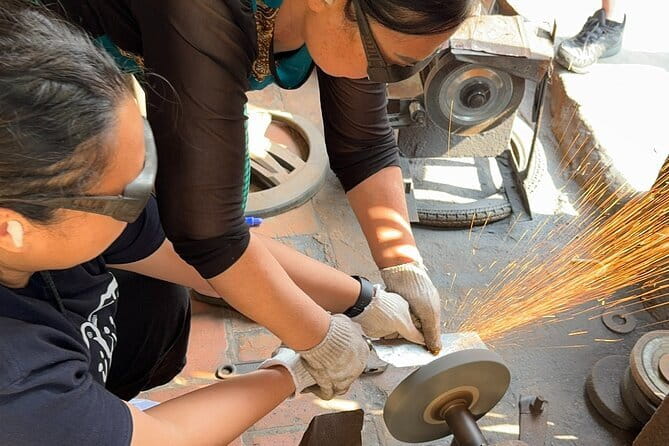
Book this if you want a hands-on craft with real skill behind it. If you like learning by doing, this class fits. You will sketch your own blade, forge it, and then sharpen it, guided by artisans in a fully equipped workshop.
It is also a strong choice if you care about authenticity over performance. The focus on Da Sy’s long forging tradition and the standout female-led instruction makes it feel more human and grounded than a typical “souvenir factory.”
You might skip it if you are hoping for something low effort. This experience involves heat, hammering, and grindstone sharpening steps. If you want calm, quiet sightseeing, this may feel too intense.
Should You Book This Hanoi Knife-Making Class or Skip It?
I think you should book it if you want one memorable, practical activity in Hanoi that ends with something you made yourself and can use. The combination of small group size, tool-provided convenience, step-by-step instruction, and the tar-based sharpening technique makes it hard to replace with another workshop.
If you are sensitive to loud grinding noises or you want a purely relaxing day, consider that this class asks you to get involved. Also, if you plan to fly after your trip, check knife transport rules early so your finished knife does not cause last-minute stress.
If you get the timing right, this is one of those rare travel experiences where the result is more than a photo. It is a tool, with a story you can actually hold.
FAQ
How long is the Hanoi knife-making class?
The class runs for about 2 hours 30 minutes (approximately).
Where does the class start and finish?
It starts at Đa Sỹ, Kiến Hưng, Hà Đông, Hà Nội, Vietnam. The activity ends back at the meeting point.
How much does it cost?
The price is $45.51 per person.
Is a mobile ticket provided?
Yes, the experience includes a mobile ticket.
What is included in the class?
All tools are provided at the artisan’s house, along with the necessary safety equipment for knife making.
Do I get to make the knife myself?
Yes. The workshop is hands-on, and you design, forge, shape, and sharpen your own knife.
Is the tar-based sharpening technique part of the experience?
Yes. Sharpening includes several steps, including a tar-based wash described as a rare technique.
How many people are in the group?
The class has a maximum of 10 travelers.
Are service animals allowed?
Yes, service animals are allowed.
Is gratuity included in the price?
Gratuities are not included. They are optional.
What is the cancellation refund window?
Free cancellation is available. You can cancel up to 24 hours in advance for a full refund, based on local time.
New listings around Hanoi
- Ninh Binh Full Day Tour from Hanoi to Hoa Lu, Trang An & Mua Cave★ 5.0 · 31 reviews
- Beautiful Female Riders Vespa Red River Countryside Tour 5 Hours★ 5.0 · 23 reviews
- Female Riders Vespa Night Street Food + Train Street food 4 Hours★ 5.0 · 35 reviews
- The insider’s Hanoi 4.5 hours All highlight Places & Train Street★ 5.0 · 41 reviews
- Street Foods Hanoi Kim Tours Vietnam★ 5.0 · 140 reviews
- Red River Delta Countryside+ Rural Villages, rice Paddies fields★ 5.0 · 134 reviews
- 5 Days 4 Nights Highlight Vietnam Tours★ 5.0 · 9 reviews
- Hanoi Vespa After Dark Street food + Train Street+ Live Music★ 5.0 · 18 reviews
Workshops, compared.

Hanoi Cooking Class: Culture, Local Market & Meaning CSR Impact
Read our review →
5 Traditional Dishes Hanoi Cooking Class with Market Trip
Read our review →
Vietnamese Coffee Culture and Coffee Making Class
Read our review →

Cooking Class Hoi An:Local Market, Basket Boat, Fishing & Cooking
Read our review →
Hoi An Cooking Class(Market,BasketBoat Crabfishing&Cooking Class)
Read our review →
Market Tour, Basket Boat Ride and Cooking Class
Read our review →
Hoi An Full Lantern Making Class- A special Foldable lantern
Read our review →Browse the lists this tour appears in